We saw lots of bewilderbeast droppings and lots of bewilderbeasts – many with tiny calves, meals on wobbly hooves to the lions and cheetahs. The big male lion had helped himself to a giraffe calf, so fat pickings this summer. The lions were recently introduced to shake things up in Mkhuze, apparently four in Nov 2013 and four in 2014. So the edible animals are probably on high alert, muttering to each other ‘there goes the neighbourhood.’
– wobbly hooves – – hmmm, I’ll have one of those! –
Jess and I watched with bated breath as this cheetah and its mate launched into a flat-out sprint after the wildebeasts they’d been watching, but they disappeared before we could see any outcome.
– impala nursery or creche on the banks of Nsumo Pan – – ugh, I ate too much giraffe –
Friends saw the lionesses bring down a wildebeast calf right in front of them at the waterhole. Lots of square-lipped rhino, a baboon sentry up a tree; and a beautiful hunting wasp, all yellow and black rugby jersey colours. Wonderful Mkhuze birdlife as always, 106 species, with cuckoo hawk, nicator, grey-headed bush shrike, wattled lapwing and pygmy kingfisher being my highlights.
Then at last: A hook-lipped rhino! We’ve only seen a few of those over the years. He stood obligingly while we took pictures.
He just stood there as placid as anything. I had long told Jess if we were lucky enough to see one we’d probly just get a glimpse, so she should be ready with her camera! So there’s yet another reason to take everything your parents say with a great big sack of cerebos.
We had lovely weather, including rain, wind and too hot, but mostly perfect, as all the others were short duration and actually pleasant. It’s dry again, so the waterholes were busy. Three of the lady lions launched a run on a wildebeast calf at the waterhole as we watched. Other voyeurs (among whom friend Geoff Kay) told of watching them kill and eat one the day before.
We dipped on eles. Again. Not one; and not a single elephant turd neither. Not one. We drove 450km over the six days and the reward I offered of an ice cream to she who spotted an ele turd (not a whole ele, just a fresh-ish turd!) went unclaimed!
It reminded me of a Free State Reed-ism: “Not a leaf stirred. Not an elephant stirred (geddit?)”
Some things I love about Mkhuze: Those dirt roads between the fever trees (there’s lotsa tar too, these days). Few people. Polite people even at a lion kill (‘After you! No, after YOU!’). Lots of birds.
– Fever tree dirt track Mkhuze –
African time; African efficiency. We had electricity – at times, but not at our site, which I found out after I’d set up camp fully. Couldn’t test, as the generator only runs from 5pm to 10am – which is plenty, but you can’t find out if your site is working if you arrive when it’s not running. No problem, I set up a field kitchen 60m away from my site. We had water – at times. Even hot water at times. The bins had monkey- and baboon-proof lids – some of them.
FRIENDLY inefficient staff: Got any charcoal? Yes. Where? There. You’d looked there, but you go and look again: fokol. Go back. Doesn’t seem to be any. Yes, it is there. Where? I show you. None. HAU!! It was here! Screech of laughter: Hau! So she goes and fetches extra from the stores, hosing herself at the fact that ‘Strue’s Bob, there wasn’t any when she thought there was!
At the waterhole a sexy young thing with a 400mm lens got chatting away to this 59yr old. She musta been 19 in the shade. Burbling away about look at that and watch here for the pygmy kingfisher and have you seen the lions behind that bush and the poor wildebees calf lost its mother and the lions nearly ate it and etc. Fairly unusual for a Seffrican she was. My 17yr old can seldom string two words together to a stranger!
Very little ranger or staff presence so the ous were up and out on game drives well before the meant-to-be time of 5am.
Patrick the ranger on a game drive in his open top Landie stopped me – he recognised us from two previous visits when we went on drives and walks with him – and asked again, ‘Where’s the boy?’ Remarkable really, as the one visit was in May and the other in 2009! I spose we do stand out a bit. I told him Tom thought he’d rather be eaten by a lion than endure two teenage girls for six days.
Mkhuze very dry and huge tracts recently burnt. The water hole was muddy and hugely popular. Everyone took turns to churn up the mud and poo n pee in it! As thirsty as they were (they would come running up to it, keen to drink) they showed great reluctance to actually start drinking. But they had no choice. This morning one of the wildebeests was lying dead next to the edge. Unmarked. We speculated one of the rhinos had reprimanded it (they had “baleka’d” anything that came near to them as we watched them drink).
The only thing that baleka’d them was a male warthog. When a rhino said to him voetsack, he said No, YOU voetsack and made the rhino move over. Courage! ~~~oo0oo~~~ Note to self: There’s LOTS that needs fixing with your camping equipment! I forgot the braai grid and couldn’t find one in six shops in Mkhuze village 18km away. I took the wrong gas bottle, didn’t fit. No problem, the girls got cold food* and hot tea – I had grabbed the electric kettle from the kitchen as I left home.
As always, the fridge worked a treat, so in the heat they got plenty of ice-cold drinks and water.
Next time I’m gonna be SO organised . . . *Don’t feel sorry for them! They got some toasted sarmies from the Rhino Dino once or twice – and Phindile also made us one lekker breakfast.
~~~oo0oo~~~
fokol – none
Hau! – goodness gracious me
baleka – move away! fuckoff! language isiZulu
voetsack – pr: footsack; move away! fuckoff! language Afrikaans
I heard a cry on high as I parked on the roof at work. Glancing up I saw two crows cartwheeling, freewheeling, locking claws and spiralling like a propellor high above me. What a magnificent display of flying excellence!
Buzzing around above and below them was a drongo, divebombing and harrassing them, cheeky little blighter. They ignored him and carried on exuberantly showing off. Wow!
Isn’t that amazing!? I said to my 74yr old carguard Bridget as she shuffled up asking “And now?“.
I pointed out the birds. “Yes,” she says off-handedly, “Those two parents are teaching the young one to fly”.
Jess and her two mates giggled away the weekend looking for big beasts. Elephants was what they were after, but they stayed in hiding. Eventually we were placing bets on seeing elephant poo! not even the whole animal! Still no luck. We saw lots of rhino and a a few buffalo instead. Plenty antelope and lots & lots of birds. Beautiful.
Evenings they watched movies while I read Bill Bryson’s Short History of Nearly Everything (again!) and listened to the nightjar.
Mkhuze is very dry, so all the animals from miles around crowd the waterhole. Mudhole, really – very little water. Amazing that just a few miles away at Nsumo Pan there is miles of shoreline and clear blue water, but we saw very few animals there. Just hippos. Wisely croc-shy, maybe?
Dunno if it was this visit or another, but in walking around the camp I saw the bluest bird I’d ever seen – and it was a Black Cuckooshrike! I would have confidently asserted to you that Black Cuckooshrikes are black. Well, usually, but have a good look in bright sunlight:
– ’twas just like this – – the blue of the Black Cuckooshrike – from ethiobirds.smugmug.com – thanks –
Tom back in civilization had a ball too. His weekend was very different to ours: beach, shopping mall, KFC, two movies, a home in Durban North with dogs and pet pythons. Plus he was given three shad his host had caught. He brought them home, scaled them, filleted them and fried them with fresh-cut potato chips. Delicious! Quite the chef, my Tom!
She died recently, so I thought of the fun she brought us, and that one time I went to her show. Here’s Zapiro’s take on her funeral:
She was 40yrs old. She was delightfully rude.
Hollywood Reporter – August 1, 1973
Bravo Sid Gathrid of Caesar’s Palace for giving the summer crowds one of the freshest, brightest and most entertaining bookings of the year in the lady stars Petula Clark and Joan Rivers. Destroying the old hand-me-down Strip myth that two females are artistically incompatible and or have ineffectual drawing power, Pet and Joan’s opening string of standingroom-only crowds found the duo irresistible.
There’s a delightful mix-up of interplay of the stars’ talents; Petula does comedy bits and Joan sings! The “raid” on the other’s forte only adds to the evening’s abundance of style, polish and charm.
Songs Performed:
Color My World/You Are the Sunshine of My Life Don’t Sleep in the Subway – – – – – LISTEN:http://www.dailymotion.com/video/x2obt60_petula-clark-don-t-sleep-in-the-subway-w-lyrics_music Beatles medley: Something/Penny Lane/All You Need is Love You and I (from Goodbye Mr. Chips) I Couldn’t Live Without Your Love (How about them grits) Your Cheatin’ Heart You’ve Got a Friend Band introductions I Don’t Know How to Love Him (from Jesus Christ Superstar) What the World Needs Now Downtown —————————————- I went with Jim & Katie Patterson, wonderful host family, and Dottie Moffett, kind friend (who had been an exchange student to Cape Town the year before).
Greg Seibert was an exchange student to Harrismith back in 1972. He mailed me in 2014 to say his brother Jeff was coming to SA for work in Port Elizabeth. He’s with General Motors. I said get him up to KZN and we can go to a game reserve. Short notice, so I booked Hluhluwe.
– eles in the mist –
Greg thought he may join us but it didn’t happen. Very sadly.
~~~~~ooo000ooo~~~~~
I wrote to friends after: Hared off at short notice to Hluhluwe-Mfolosi park. Harrismith’s 1972 Rotary exchange student Greg Seibert contacted me to say his brother was in SA. He works for General Motors and I spose he was checking to see if they still sell Chevs in this neck of the woods. He’s from just outside Detroit, Michigan.
Mfolosi was dry and Hluhluwe was burnt, the logs still smouldering from a fire that burnt about half the park. Lots to see in the line of big grey animals plus antelope and painted dogs. Lots of birds, too.
Photogiraffing? It’s hard to photograph giraffe in Ithala Game Reserve when you have a Jack-in-the-Box popping up in the jeep right in front of your lens every time you’re ready to depress the shutter. And then the laughter gives camera shake.
Geoffrey Caruth is a doer. He gets going. He has run an indigenous nursery in an industrial area for decades, he ran an Olde Heritage Shoppe for years, he built a pond in a park – as a donation to the people of Westville; he has a lovely young (much younger!) wife and two ugly old dogs. He lives on the bank of the Palmiet river, on the boundary of the Palmiet Nature Reserve. Sure, he thinks that to be an Englishman is to have won the lottery in life, but hey, even he’s not perfect.
Recently he decided to re-introduce bushbuck into the 100ha Palmiet Nature Reserve in Westville, KwaZulu Natal and – typically – got off his butt. I would have talked about it, he rallied the troops. The bushbuck or imbabala (Tragelaphus sylvaticus) should be eminently suited to our valley and we hope they’ll thrive here.
So this week, 18 months after he decided to launch “Operation Nkonka”, we were in the Palmiet watching five beautiful bushbuck, three females and two males, jump out of the back of the truck and explore their new home.
Geoff and Warren Friedman watch with pride and angst:
A = Release site
B = Where I last saw a bushbuck
C = Our home
Later four more were released. Soon we’ll be fawning over their offspring, we hope!
~~~~~ooo000ooo~~~~~
nkonka is isiZulu for male bushbuck;
bushbuck in general are imbabala; the Cape bushbuck is our species; the other is the Harnessed bushbuck or kéwel, a different species in west and central Africa. Convergent evolution has them looking very similar but ours is closely related to the Bongo and the Sitatunga while the Harnessed is closer to the Nyala. The Nyala has the wonderful Latin name Tragelaphus angasi – you can imagine how that came about! (angazi in isiZulu can mean ‘I don’t know’).
On 2014/06/23 Crispin Hemson – Pigeon Valley Patriarch and Monarch – wrote: Conditions in Pigeon Valley are very dry, giving great visibility into the undergrowth. We are suddenly seeing Buff-spotted Flufftails on the main track, or just next to it. Yesterday I saw two adults and a sub-adult. These are very unobtrusive birds, so do not expect rustling. I suspect that while in summer the undergrowth is dim and the main track bright, the Flufftails stay under cover. In winter the undergrowth is as bright as the area just outside it, so the pressure to stay there is less. Spotted Ground-Thrushes are also very visible, often just on the edge of the main track, digging into leaf litter that accumulates there. There are more than I originally thought – I saw them in four places up the track yesterday.
I wrote:
I have heard a thousand bufftails – particularly at Hella Hella where we weekend-ed monthly for ten to fifteen years, and on the Mkombaan river in Westville where we lived for fifteen years; and although I searched and stalked and lay in wait, and saw two dead ones – next-door-cat-got-it in River Drive, and flew-into-plate-glass at Hella Hella – a sighting has evaded me till now. One would hoot right outside my bedroom window, metres away, but I never caught a glimpse.
– I forget whose pic this is! –
Thanks to Pigeon Valley’s tireless champion, Crispin Hemson reporting on his birding regularly, I went on Sunday to Pigeon Valley and saw a spotted thrush at the entrance, and then that flufftail up at the fence line along King George V avenue. At last! Two seconds after forty years!
A male bird, who ducked into low dense thicket just outside the fence.
– another of Crispin’s pics –
This was a big bogey bird as far as a sighting goes! Must be close to forty years of thinking “soon I’ll see one”.
Can a pitta in my garden be far behind?
~~~oo0oo~~~
Here’s a Sheryl Halstead Spotted Ground Thrush pic
In Tsavo East we walked down a long underground tunnel from Elephant Hills Lodge on the hilltop in the first pic below, to the waterhole below the hill, where the tunnel ends in an iron-barred underground hide looking out at elephant feet and buffalo legs as they drink within pebble-tossing distance. Almost.
– bottom left is where the tunnel emerges –
In Tsavo West we climbed down into an old metal tank with glass portholes looking out into the crystal clear waters of Mzima Spring, where fish swim past and hippos can be seen looking like graceful ballerinas who have ‘let themselves go’ as they move daintily by, holding their breath. We watched and waited and held our breath, but not one of them farted while we were there.
down into the tankunderwater view of fish & hippos!There’s the underwater observation tank opposite
The spring bubbles out of the hillside volcanic rock, crystal clear and forming a sizeable stream.
– bubbling out of the volcanic rock: The start of a river –hippos in clear waterMzima springs– Mzima Springs –
NB – Very important update 2025 – before visiting any of these areas, check about the safety of the area and the availability of amenities beforehand.
Just back from a Five Days, Five Forests birding trip to Zululand: Nkandla, Entumeni, Dlinza and Ngoye Forests. These are mistbelt or scarp or afromontane forests; and the fifth forest was St Lucia coastal forest. (2013)
My highlight was Ngoye, about which I’ve heard so much over the years. Especially after Aitch went without me: “Have you been to Ngoye Koos? Oh, no, I remember, you haven’t. So you haven’t seen the Woodwards Barbet then? I HAVE!” Only about a hundred times, she rubbed it in!
COMFORT This trip was just me and a great guide. Sakhamuzi was lovely quiet company. Nights at the B&Bs and the Birders’ Cottage we cooked up a red meat storm, washed it all down with frosties and early to bed. On walks I took my binocs, telescope, rucksack and we each carried a deckchair. Mostly we simply found great spots like forest edges or a good tree and parked. Sakhamuzi said (well, he would, wouldn’t he?) that he enjoyed sitting still. He said mostly birders want to rush from one spot to the next, talking all the time! I said he should get deckchairs and specialise in khehlas and gogos. ‘Charge a premium, carry a hebcooler and you’ll make your fortune, young man,’ was my advice to him! Find a fruiting tree, and let the birds flutter to your doddery customers.
I took plenty snacks and drinks in my rucksack, so the waiting was comfy, luxurious and munchy. Next time I’ll take some poncho or dark sheet to break the human outline – see if that fools the voëls.
We stayed two nights in the Birders Cottage in Ngoye. Perfect for getting up before five every morning and getting straight into the forest at first light. Saw and heard lots of birds which I’d seen before but had written BVD next to them (“better view desired”) and one great lifer. Yes, Aitch-In-The-Clouds, I did the see the barbet, so I laid that bogey-bird to rest!
– thanks ebird.org –
The Green BarbetStactolaema olivacea used to be called Woodward’s Barbet – our sub-species is Stactolaema olivaceawoodwardi. This beautiful 1897 illustration of a pair of Woodward’s barbets, by J.G. Keulemans
Also a special in the forest is the oNgoye red squirrel, Paraxerus palliatus ornatus and I can’t remember if we saw him! I’ll have to go back! Illustration by Joseph Wolf, Zoological Society of London 1864.
WHEELS Craig Naude’s magic silver and blue Mitsubishi Colt 4X4 V6 3000 was superb. That’s it above left in the grasslands above the forest – one of the few pictures I took! I needed first gear low ratio in places in the forest where the rutted tracks changed to slippery clay, and steep drops into stream beds meant equally steep climbs out of them, starting at snail’s pace. Boy heaven.
COASTAL FOREST At St Lucia we also got into the forest at dawn, then walked on to the mouth of the estuary by 6.30am at low tide. Waders and terns remain confusing to me, and the sooty tern Sakhamuzi hoped to spot had trekked back to Mozambique. Pity, as it’s one of the easier ones to ID. Oh, well, as the baby tern said to the mother tern: Can I have a baby brother? Certainly, said the mother tern: ‘One good tern deserves another.’
– St Lucia estuary with a grey heron in the surf – my poor pic! –
On the way back we spotted a dwarf chameleon, which I now know was probably the endangered Setaro’s Dwarf Chameleon. No picture! Then we sat in the forest in comfort again and a Green Malkoha (old green coucal) obligingly flew into a tree and leisurely displayed his banana beak in full sunlight. No picture! I’d seen one in Malawi this was a first for Southern Africa.
– thanks Johann vd Berg on stellenboschbirds.org – beaut pic!! –
Driving back to the B&B a Lemon Dove (old cinnamon dove) sat on a track at the side of the road for so long we eventually drove off! First time I’ve ever done that. Usually you just glimpse them flying off at speed. Another early night after red meat and beer was enjoyed.
What a great break – the first real birding since before Aitch and I became child-infested. I’d forgotten what early mornings without scarecrows was like! We spent 32 days on our trip up to Malawi when the kids were 5 and 1 and only saw one bird, and that was a Zambian nkuku whose cousin was deliciously on our plates at a shisanyama at the roadside in Livingstone. I exaggerate. Slightly.
~~oo0oo~~
Bruce Soutar wrote: Pete – eye think this is a compliment – from Rooooth Garland: Please tell Piet I LOVE his stories and want to see more . . . He makes me smile, even though he’s a drunkard and no good at flying. Does he have a blogspot I can sign up for? XxPS: Sakumuzi is a huge Twinstreams fan . . . Lovely man. Ruth Garland – Sydney Australia
Ruth’s Dad was the legendary Ian Garland, whose exploits at Twinstreams in Zululand did heaps to save, propagate and teach about indigenous plants. Ruth’s exploits at Mbona in a low-flying kombi were a different chapter, which also did heaps to save and teach, but not propagate. And she’s the drunkard.
~~oo0oo~~
khehlas and gogos – Old men and Old ladies
gugile – ancient, as in buggered; decrepit; you know; don’t pretend you don’t know
voëls – birds
nkuku – chicken
shisanyama – red meat on red hot coals restaurant; not teetotal joints; licenced to sell alcohol, ‘Which’ – as famous birder Ian Sinclair said with a grin – ‘I’m licenced to drink’
~~oo0oo~~
My Bird List in Nkandla Forest:Lemon Dove; Dusky Flycatcher; Blue-Mantled Flycatcher;Knysna Turaco; Red-eyed Dove; Redbilled Wood-Hoopoe; Greater Double-collared Sunbird; Grey Cuckoo Shrike; Rameron Pigeon; Black-headed Oriole; Cape Batis; Black Saw-wing; HEARD: Dark-backed Weaver; Emerald Cuckoo; Chinspot Batis;
My Bird List in Entumeni Forest:Narina Trogon; Cape Batis; Olive Sunbird; Terrestrial Brownbul
My Bird list St Lucia and in St Lucia coastal forest: Woodwards Batis; Rudd’s Apalis; Yellow-bellied Greenbul; Green Malkoha – LIFER in South Africa for me – full sunlight saturation view; Grey Sunbird; Livingstone’s Turaco; Burchell’s Coucal; Whimbrel; Osprey; Grey Heron; Fish Eagle; Spoonbill; Yellow Weaver; Green Pigeon; Speckled Mousebird; Swift Tern; Black-winged Stilt; Avocet; YB Stork; Pink-backed Pelican; Little Tern; Three-banded Plover; Blue-cheeked Bee-eater;Lemon Dove – saturation close-up; Crested Guineafowl; Pied Wagtail; Cape Wagtail; Goliath Heron; Great White Egret; Little Egret; Thickbilled Weaver; White-breasted Cormorant; Palm Swift; Brown-throated Martin; Black or Common Swift; Chorister Robin-chat; Crowned Hornbill;
My Bird list in Ngoye Forest:Green Barbet – LIFER for me (yes, I know, Aitch); Yellow-streaked Greenbul; Tambourine Dove; Delegorgue’s Pigeon; Crowned Hornbill; Olive Woodpecker; GT Woodpecker; Orange-breasted Bush Shrike; Mountain Wagtail; Red-eyed Dove; Hadeda Ibis; Narina Trogon; HEARD: Wood Owl; Diederik Cuckoo;
Other creatures on the trip: Samango monkey; Red Squirrel; Thick-tailed Bushbaby (heard at night); Rainbow Skink; Banded Forester Butterfly;
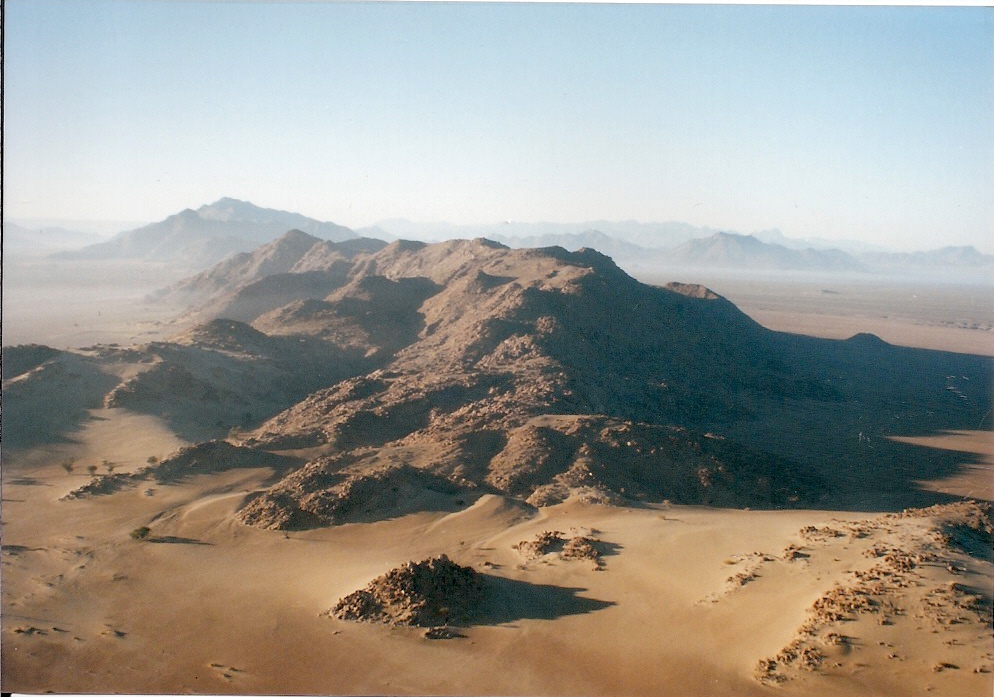
Up in a hot air balloon with Aitch high over Sossusvlei in the Namib desert. Up in the pre-dawn, we go and fetch the sun from where he’s snuggling, reluctant to get out of bed. Beautiful to see a sunrise while the ground below you is still in darkness. Later the sun actually rises for the earthlings below us and the trees start throwing lo-ong shadows. A 10m tree has a 200m shadow on the sand. We rise high, then sink down till we’re zooming at treetop level, then soar up again till the trees are little specks and only a dust trail shows where the ground crew is chasing after us, estimating where we’ll land. The intermittent roar of the gas flame is harsh, making the silence between bursts even more special and serene.
We land and our swashbuckling pirate-pilot smacks the head off a champagne bottle with his sabre. Bubbly and breakfast in the cool early morning standing around a table decked with a pretty tablecloth.
Aitch and I went to Mombasa in 1998 and checked in at a hotel on Diani beach. The next day I got a lift into town and walked the crowded streets of Mombasa looking for a cheap hired car. Mombasa is quite a place:
I did my sums. I’m meticulous. Not.
– car hire – lots of choice –
While I was on safari hunting hired cars, Aitch chilled on the uncrowded beach and pooldeck, no doubt quaffing ginless gin&tonics. She used to do that, you know! Tonic & bitters. Ginless! I know! You’re right; Search me; Where’s the medicinal value? The personality enhancing factor, PEF? Still, she loved it.
After careful stalking, keeping downwind of my prey and pinpoint aiming, my lone hunting expedition was successful; I found a lil Suzuki jeep. Marvelous. I could turn round from the drivers seat and touch the back window! Almost. I knew they were good cos my chairman Allister told me, and he knows things, him being a Suzuki driver himself. Also JonDinDin once drowned his in the Tugela estuary, pulled it out and it still worked. We had wheels!
Good Birding Advice: Back at the hotel I went for a walk, leather hat on my head, binoculars round my neck. An old man came cranking along slowly on a bicycle, swung his right leg high up over the saddle and dismounted next to me.
‘Ah!’ he said,‘I can see you are English.’ I didn’t contradict him. ‘You are looking for buds,’ he said, also in a way that made me not argue. ‘There are no buds here,’ he said emphatically. ‘If you want to see buds you must go to the west, to the Impenetrable Forest. There are many buds there.’ After I thanked him for this sage advice he put his left foot on the pedal, gave a push and, swinging his right leg high over the saddle, wobbled off. After a few yards he had a thought, slowed, swung off in the same elaborate dismount and came back to me: ‘But in this hotel over here you can see some peacocks in the garden,’ he informed me re-assuringly.
‘Ah, thank you sir. Thanks very much,’ I said, wishing him well and thinking of Kenya’s 1100 species of birds – eleven percent of the world’s total. The USA has about 900, and the UK about 600. He was a character a bit like this:
Good Traveling Advice: We also got pessimistic advice on the roads. We were on our way to Tsavo National Park the next day and we wanted to avoid the main road to Nairobi. We’d heard it was crowded with trucks and buses and we’d rather avoid that, if at all possible. On our Globetrotter map I found a little road south-west of the main road – an alternative route via Kwale, Kinango and Samburu.
‘No you can’t; No, not at all; There’s no way,’ says everyone. Even the barman! Even after I said, And Have One Yourself! he still said no. ‘The bridge has been washed away by cyclone Demoina,’ they all said. This was a bit weird, as Demoina had been in 1984, fourteen years earlier, and had mostly hit Madagascar, then Mocambique, then KwaZuluNatal, well south of Kenya.
Usually I can eventually find ONE person to say ‘Don’t listen to them, the road is FINE,’ but this time I was stymied. No-one would say ‘Yes!’ nor even ‘Maybe.’
SO: We headed off along the road toward Kwale anyway. ‘Tis easier to seek forgiveness than permission, we thought. Aitch, what a trooper, was right behind me in adventurousness and right beside me in Suzukiness. ‘We’ll see new places,’ was all she said. She knows me.
As we neared Kwale a minibus taxi approaching from the other direction did a strange thing: They actually flagged us down to tell us ‘Stop! You can’t go this way! The bridge is gone, Demoina washed it away!’ We nodded, acted surprised, looked grateful, agreed, and thanked them kindly; then we kept going.
And they were right: The bridge over the river between Kwale and Kinango had indeed washed away. But there were recent tyre tracks down to the river which we followed. Below and just upstream of the iron wreckage of the bridge we stuck the Suzuki in 4X4 and crossed the low river. Then we stopped for a break, parking our mini-4X4 under a beautiful shady tree on the river bank:
– –
And we were right: Besides being devoid of traffic, the road surface was mostly good, sometimes great:
But the road was fine – in a Suzuki– smooth highway –
Then the honeymoon ended: We ran out of detour and got back onto the main, ‘tarred’ Mombasa-Nairobi road at Samburu: Aargh! It was a tar road in that every so often a big lonely blob of tar would threaten to cause damage. Huge holes between blobs had the traffic all weaving from side to side, so trucks seem to be coming straight at you, but it’s actually quite safe, despite Aitch occasionally putting her feet up against the windscreen and yelling at me that there was an oncoming truck. Like I couldn’t see it. We were like Richard and Hyacinth from Keeping Up Appearances on the BBC.
Its rather like slow-motion ballet. Most cars and all trucks went slowly, the only vehicles ‘speeding’ – probably up to 60km/h – were big passenger buses with their much better – softer, longer travel – suspension.
Years later, we find the place where the bridge had washed away on online maps. Here’s the new bridge and new road on the right, with the old road just left of it, and just left of that, the drift we crossed (just left of the yellow arrow) and that beautiful tree in the top picture (red arrow) that we rested under. All the long red mud scar is new road- wasn’t there back then. The old road shows as a thinner, lighter line.
– thanks Tracks4Africa –
Then we got to Tsavo! I’d wanted to visit Tsavo since I was ten years old, and read books by Bernhard Grzimek. Armand Denis and others! Well, here I was, thirty years later! Yavuyavu! Fahari!
While we’re packing for a camping trip to Mkhuze the vervet monkeys sneak into the kitchen and grab the fresh peanuts. The peanuts grown by Thulisiwe just north of Jozini on the Makathini Flats, which she then roasts over an open fire and salts herself. Tobias brings us some whenever he goes home.
Tom spots them on the roof, spilling the nuts as they chomp them, the spilt ones rolling down the tiles into the gutter. Hey! he shouts and remonstrates and fulminates! Tom and the monkeys don’t have a good relationship despite all my lectures (um, whaddaya mean because of?).
After a while I tell him, Relax m’boy, its OK for the monkeys to have the nuts. We left them in the open, their job is to glean and gather, so that’s that.
But he doesn’t like it, and he doesn’t like them. I think it’s because he’s a bit scared of them, so I ask him:
TomTom, how big do you think the monkeys are, fella? How much do they weigh?
About 90kg, he guesses. Guess again. First, how much do you weigh?
45kg And the monkeys?
15kg?